

Gerrit Rietveld (1888 – 1964) was a joiner turned architect who transformed a simple chair into a manifesto of modern art.
His story begins at the workbench. Born in Utrecht, in the Netherlands, he learned the trade at a very young age in his father’s joinery workshop. In the evenings he took drawing and architecture classes, and worked for a time as a draughtsman for a local goldsmith. In other words, he knew wood with his hands before thinking about it on paper.
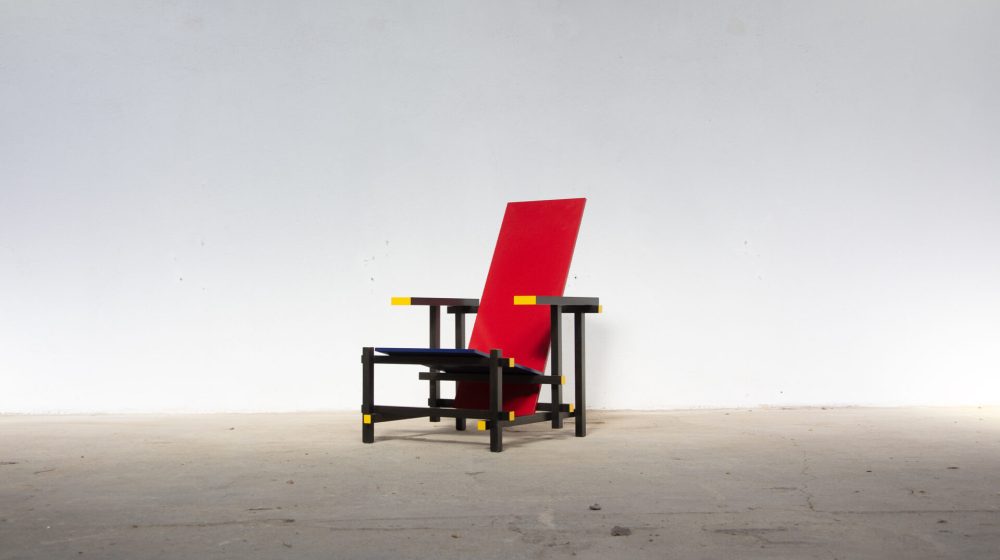
In 1917 he opened his own workshop. It was there, around 1918, that the chair that would make him famous was born: an assembly of boards and battens that cross without ever merging, like a construction in space. Repainted a few years later in red, blue, yellow and black, it became the Red and Blue Chair, the very image of the De Stijl movement, whose group Rietveld joined around Piet Mondrian and Theo van Doesburg.
In 1924 he moved up to the scale of the house. With his client and accomplice Truus Schröder-Schräder, he designed the Schröder House in Utrecht: sliding partitions, coloured planes, an interior that transforms over the course of the day. It is now a UNESCO World Heritage Site.
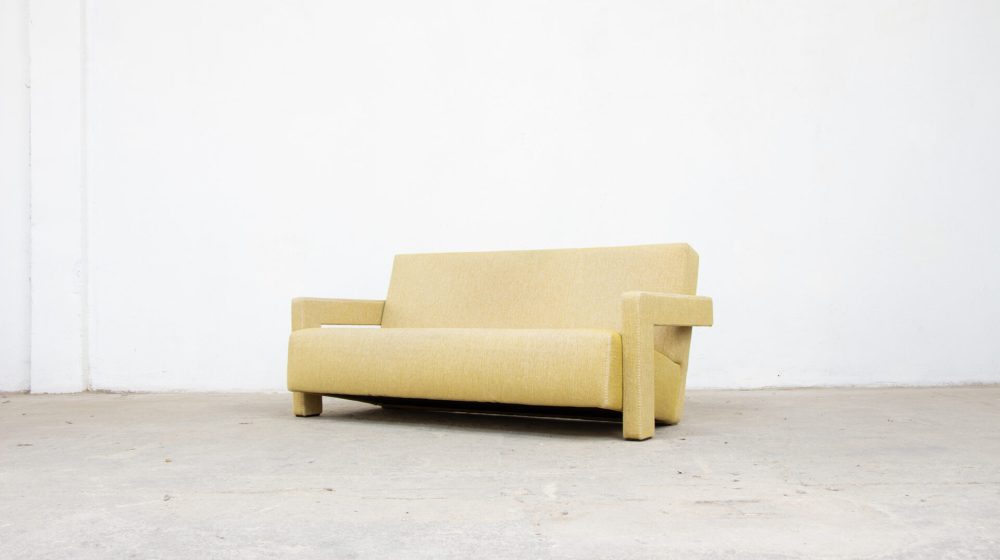
In the 1930s his style became more functional. He designed the Zig-Zag chair, cut from four boards joined in a Z, crate-wood furniture and the Utrecht armchair, with its generous volumes and cantilevered armrests. He also took part in founding the CIAM, the International Congresses of Modern Architecture, and later designed the Van Gogh Museum in Amsterdam.
What is striking about Rietveld is this freedom of mind: each piece of furniture is an experiment, a way of rethinking the object from scratch.
Choosing a piece by Gerrit Rietveld means bringing home a fragment of art history, radical, colourful and surprisingly current.